In 1985, Bill Freeman proposed an unconventional concept: what if a zipper could interlock three planes instead of just two? Experts at the time dismissed the idea, his grant application was rejected, and he shelved the patent deep in his garage. This changes everything. It took forty years for technology to finally catch up to his vision.
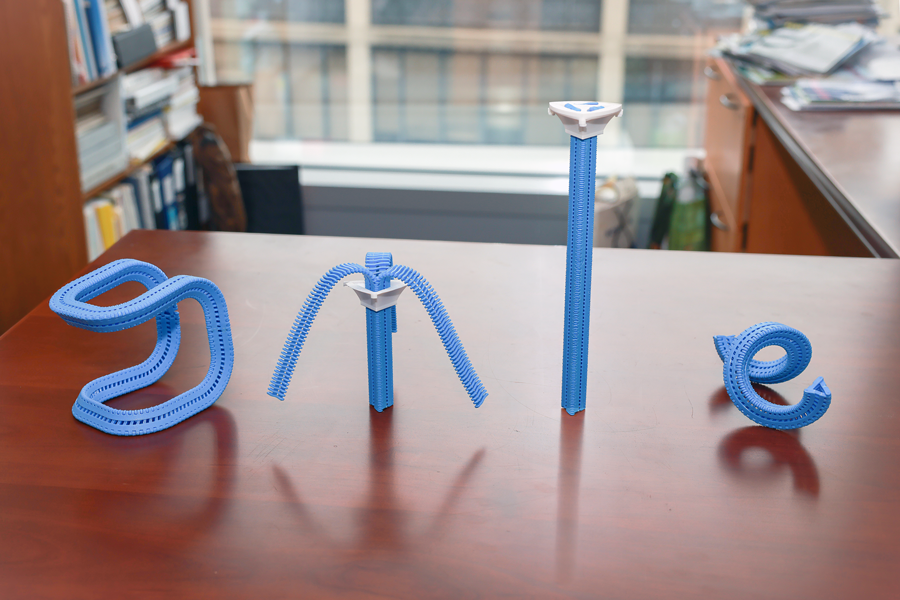
Conventional zippers are undeniably ingenious, yet inherently limited. They merely join two linear tracks—ideal for garments, but incapable of providing structural rigidity in three dimensions. Freeman, however, envisioned a three-sided mechanism with a triangular cross-section. Researchers at MIT CSAIL have now revived this archival design, realizing it through advanced computational design tools. That is precisely the point.
The key lies in the design freedom offered by additive manufacturing. Fabricating such intricate, interlocking tooth geometries using subtractive or traditional methods was previously unfeasible. Today, engineers can simply define parameters and initiate the build, tailoring bending axes, compliance profiles, and extension lengths to precise specifications.
So, what is the next step?
The MIT team engineered dedicated software that allows users to program the zipper's kinematic behavior. Rather than generating a simple linear strut, designers can select from four foundational motion primitives: straight, curved, helical, or twisting. As the slider engages, the three flexible thermoplastic profiles instantly interlock into a rigid, load-bearing framework. That is the core mechanism.
This is where the paradigm shifts. Consider the operational overhead of pitching a tent in challenging field conditions. Testing demonstrated that pitching a conventional tent manually can take up to six minutes. With this deployable architecture, deployment was accomplished in just over a minute. By affixing the zipper elements directly to the membrane, the structure snaps into a rigid form factor with a single actuation.
The obvious engineering question follows: how robust is this system under load?
Rigorous stress analysis was central to the validation process. The researchers benchmarked prototypes using two distinct polymers: PLA and TPU. PLA exhibited superior mechanical strength and load-bearing capacity, while TPU offered elevated elastomeric resilience. In automated lifecycle testing, the robotic test rig actuated the interlocking teeth through 18,000 cycles before material failure occurred. Straightforward, repeatable engineering.
Engineering ingenuity often manifests not in inventing raw components from scratch, but in reframing ubiquitous mechanical concepts. This mechanism transcends its role as a simple fastener—it acts as a functional, mechanically programmable material.
The biomedical implications are equally compelling. In orthopedic splinting and wrist orthoses, this approach offers variable stiffness. The structure can remain compliant during daytime mobility and be selectively actuated into a rigid configuration during sleep to enforce immobilization. A single, unified device dynamically conforms to therapeutic requirements under user control.
That is the policy landscape. Here is the technical breakdown.
Robotics stands to gain significantly from this innovation. The team developed a quadruped robot capable of tuning both leg length and structural stiffness via integrated zipper profiles. To clear higher obstacles, the system locks into a high-rigidity state; to maintain a low profile or absorb dynamic impact, it releases tension. Such adaptive compliance is critical for the next generation of search-and-rescue robotics.
Historically, widespread perception of consumer 3D printing often relegated it to static artifacts. This project demonstrably proves that complex kinematics and state-switching functionality can be embedded monolithically into the material itself. The research team is already exploring direct metal additive manufacturing, which will dramatically expand industrial performance limits.
Yet that is only part of the issue.
Consider emergency response applications requiring the instant deployment of temporary shelters and medical field units. Or space exploration, where payload mass and stowed volume are primary constraints; deployable structures that collapse flat and actuate into rigid frameworks are invaluable. Robotic manipulator arms built on Y-zipper kinematics could easily facilitate remote planetary sample acquisition.
Remarkably, a mechanical concept conceived decades ago is driving modern breakthroughs in morphing and deployable structures. The trade-off between compact portability and structural stability has finally been resolved—both characteristics are now integrated into a single mechanism.
Frequently Asked Questions
What materials are used to manufacture the Y-zipper?
The researchers primarily utilize PLA (polylactic acid) and TPU (thermoplastic polyurethane) filaments, depending on whether an application prioritizes structural yield strength or cyclic flexibility.
Can this technology be fabricated on standard desktop 3D printers?
Yes. Enabling production on standard desktop FDM/FFF 3D printers was a core objective, though achieving functional tolerances relies on the custom computational design software developed by the researchers.
How durable is a 3D-printed Y-zipper mechanism?
Empirical lifecycle testing showed the mechanical teeth withstood 18,000 continuous engagement and disengagement cycles before structural fatigue occurred, translating to years of reliable service under typical operational use.
Source: news.mit.edu / Alex Shipps
Share: