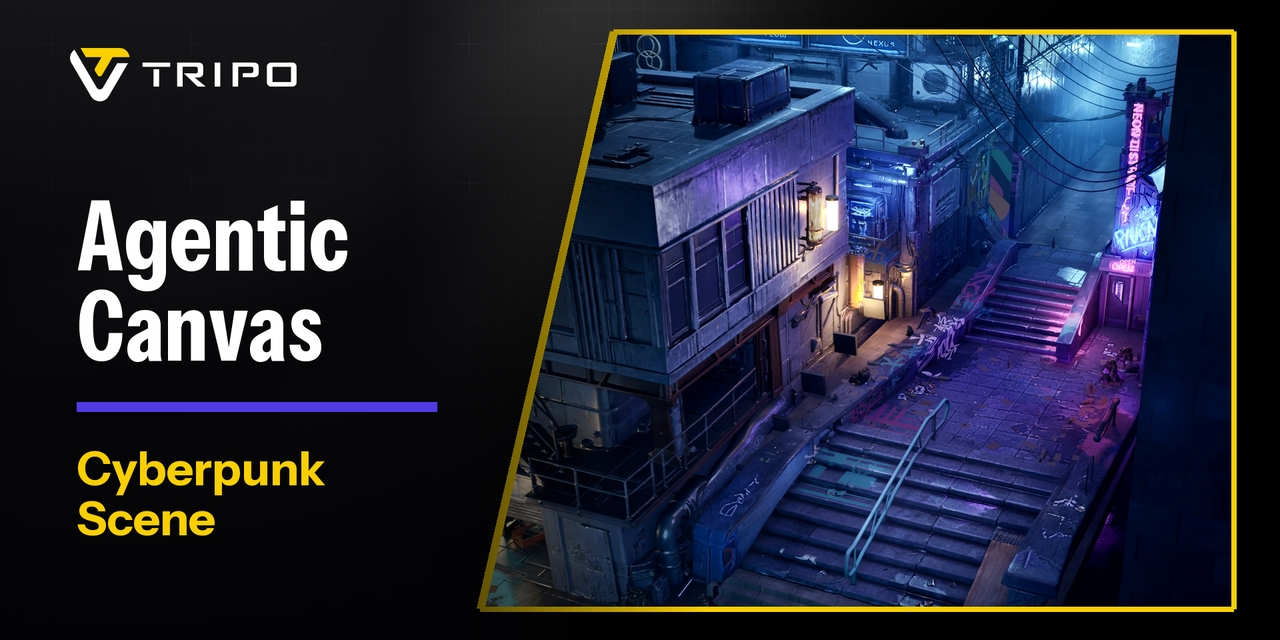
Generating a 3D model on its own is rarely sufficient to yield a result that is immediately printable or ready for integration into a game engine. Tripo AI aims to bridge this gap with the release of Agentic Canvas: this new AI agent enables complex post-processing tasks to be linked into visual, node-based workflows that can be reused and modified at any time.
How does the node-based canvas work?
Powered by Tripo’s native 3D foundational models, the system expands upon the capabilities of the former Tripo Studio. Users can provide concepts, reference images, or existing assets as inputs, which the agent transforms into a chain of interconnected operations. Each step is contained within an individual node. The feature set includes texturing, retopology, Smart UV unwrapping, PBR processing, segmentation, and rigging.
The resulting node chain is saved, allowing the same pipeline established during 3D design to be executed across an entire batch of models simultaneously. This batch processing streamlines repetitive tasks, while the AI 3D Lab node provides a conversational interface for fine-tuning parameters and saving prompt instructions.
Industry Trend: AI Agents in Post-Generation Pipelines
Tripo is not the only player focusing on the post-generation stages of 3D assets. With Hi3D Agent, Hi3D combines large language models with 3D generation, enhancing its capabilities with dedicated print-oriented features (such as mesh slicing and locating pin insertion). Meanwhile, Meshy released an extension for its Hermes Agent assistant that verifies printability, repairs geometric defects, exports to 3MF format, and transfers files directly to slicing software.
The release of Agentic Canvas clearly indicates that the role of artificial intelligence in 3D design is shifting from pure geometry generation toward automating the entire manufacturing and pre-production workflow.
Frequently Asked Questions
How can Tripo Agentic Canvas be utilized in 3D printing?
The system enables model pre-processing—such as segmentation, retopology, or chaining printing preparation steps—to be structured into an automated, reusable pipeline.
Which operations can be organized into distinct nodes?
The platform features dedicated nodes for texturing, retopology, Smart UV unwrapping, PBR processing, segmentation, and rigging tasks.
How does this differ from standard 3D model generation?
While basic generation merely yields an isolated model, Agentic Canvas bundles the entire post-processing pipeline required for 3D printing or game engines into a visually editable, batch-executable workflow.
Source: 3dprintingindustry.com / Aura Moreno
Share: