Have you ever considered what it would be like if a two-story single-family home were erected right in your yard in under two weeks, without manual labor? In Japan, this is no longer a futuristic concept, but an empirical reality. 3D concrete printing technology has finally stepped out of laboratory confines and onto commercial construction sites.
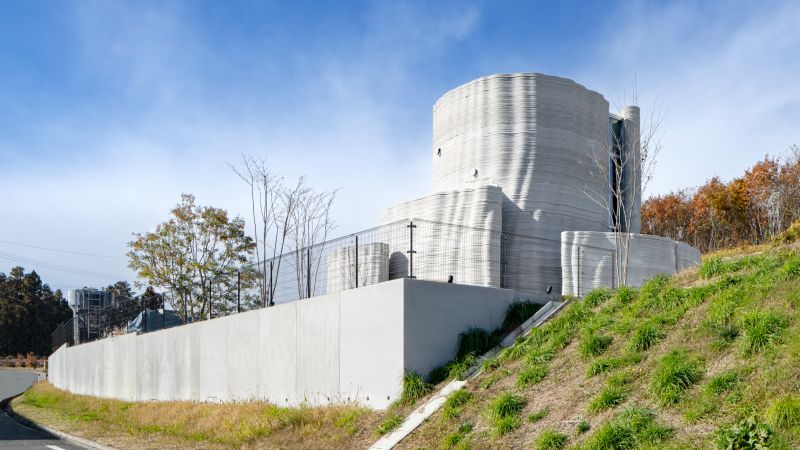
The building christened "Stealth House" was recently unveiled as the country's first fully 3D-printed two-story home. Startup Kizuki partnered with over 20 companies to demonstrate that additive manufacturing is viable far beyond small-scale applications. This project is a genuine game changer.

The construction industry is a 225-trillion-forint ($625 billion) sector currently edging toward a crisis in Japan. The population is aging, and skilled labor is dwindling rapidly. Admittedly, the skilled trades market—bricklayers, carpenters—faces similar constraints across Europe. In Japan, however, concrete projections indicate that 45 percent of the skilled workforce—approximately 1.5 million individuals—will retire within the next decade.
So, what is the solution when there is no one left to lay bricks? Robotics.
That is the policy landscape. Here is the technical breakdown.
How to Build a House in 14 Days
During the 3D concrete printing process, an expansive gantry-style system deposits the structural material layer by layer. Erecting the 50-square-meter home from foundation to roof took a mere two weeks. The throughput is extraordinary: neighbors could conceivably depart for a short vacation and return to find a fully completed structure standing next door.
Here lies the engineering challenge: in Japan, seismic resilience is paramount, and structural codes are uncompromising. The Stealth House utilizes hollow-core printed walls subsequently reinforced with an integrated reinforced concrete frame to comply with the most stringent seismic standards, reliably resolving the safety challenge.

Ultimately, the core advantage of additive construction is not merely operational velocity, but geometric flexibility. The wall contours evoke natural cavern geometries—a design that would incur prohibitive costs with conventional formwork. The gantry system, however, remains indifferent to geometric complexity; it simply executes digital toolpaths. You design it; the machine prints it.
So, what is the next step?
Obstacles and Future Outlook
A logical question arises: if the technology is this viable, why has wide-scale adoption not yet occurred? The bottleneck is not hardware or material science, but bureaucracy. Currently, each 3D-printed building requires an individualized permitting process, which delays execution. Harmonized building codes have yet to mature, and financial institutions remain conservative regarding underwriting and mortgages.
Empirically, regulatory frameworks tend to trail technological breakthroughs, but market pressures are now too significant to ignore. The Japanese government has already begun integrating these innovations into national technological development strategies. Furthermore, startups like Serendix are already printing compact, automotive-priced bungalows intended for rapid deployment in disaster-stricken areas.

Similar advancements are gaining traction globally within academic and applied engineering research. But this is not solely about home construction. 3D concrete printing has the potential to revitalize the sector's appeal to younger engineers, replacing manual wet-trade labor with digital automation managed via mobile terminals. Strenuous, hazardous labor transitions into an advanced creative technical discipline.
Moreover, the startup is preparing to launch the "3DPC Academy" to train future machine operators. Hardware alone is merely structural steel and electronics; rigorous engineering expertise remains indispensable to operate it.
Frequently Asked Questions
How durable is a 3D-printed house?
In the case of the Stealth House, reinforced concrete was integrated into the printed matrix, providing structural integrity and longevity on par with modern conventionally built structures.
Is it cheaper than conventional construction?
Currently, high initial capital expenditure on hardware means it is not inherently cheaper; however, dramatic reductions in on-site labor and material waste yield substantial cost efficiencies over larger project scales.
Can any architectural geometry be printed?
Practically speaking, yes. The primary structural advantage of additive manufacturing is its ability to fabricate curved, non-standard, and organic surfaces without the cost premiums of custom formwork.
Source: edition.cnn.com / Rebecca Cairns
Share: