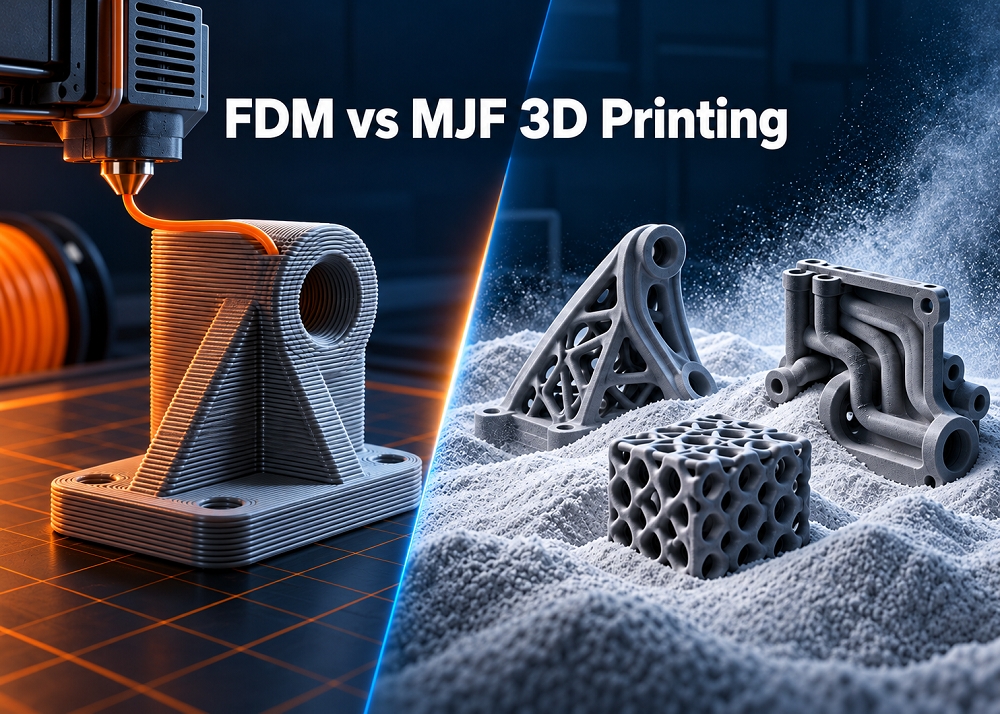
For the toolless manufacturing of thermoplastic parts, both FDM (Fused Deposition Modeling) and MJF (Multi Jet Fusion) technologies are outstanding choices; however, their operating principles, material portfolios, and cost structures differ significantly. Selecting the appropriate manufacturing method depends on production volume, geometric complexity, and mechanical requirements.
Operating Principles and Process Mechanics
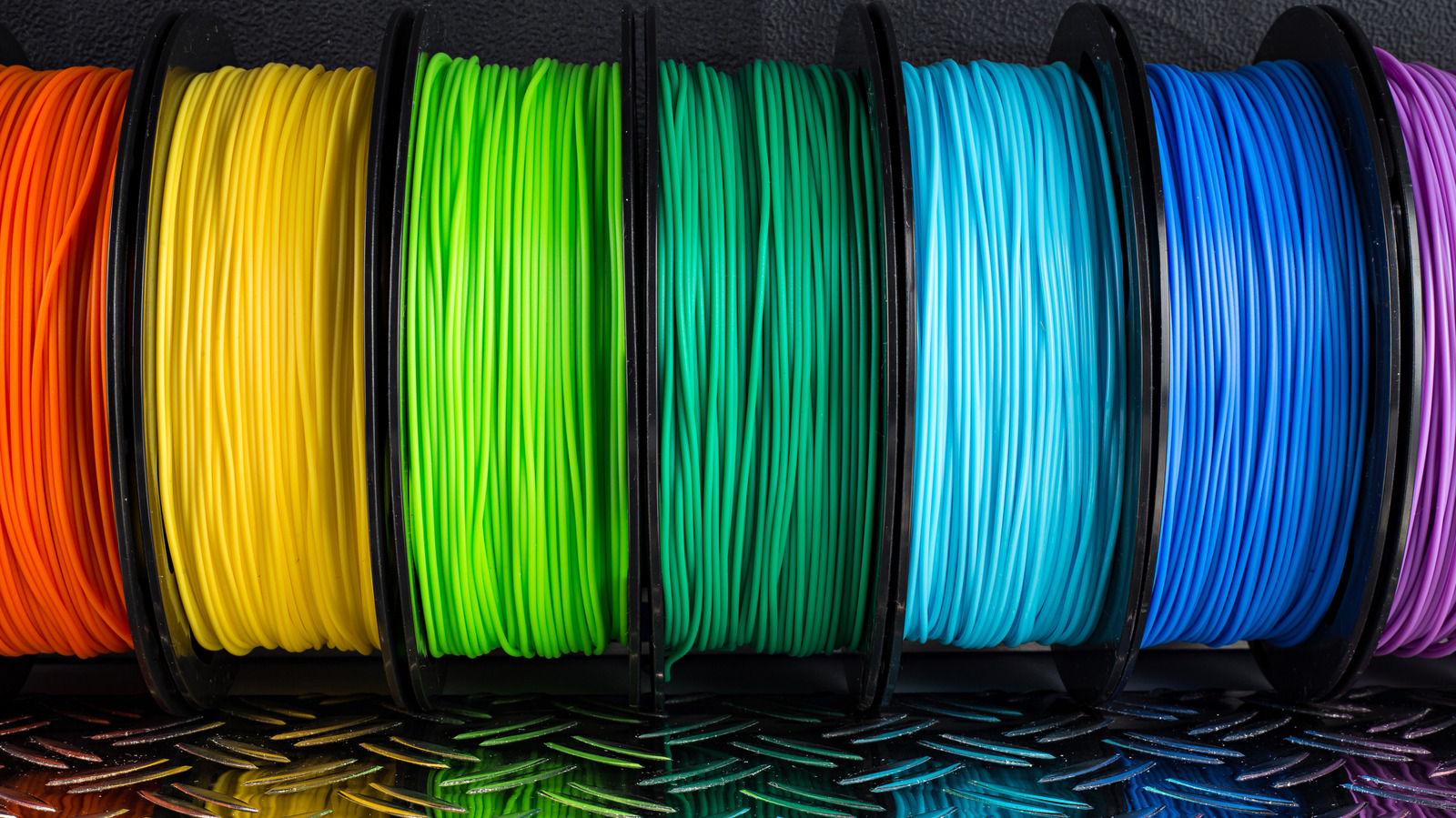
FDM technology constructs parts layer by layer by extruding molten thermoplastic filament through a nozzle. Consequently, part orientation directly dictates interlaminar shear strength, while overhanging geometries necessitate support structures that require post-print removal.
In contrast, MJF is a powder bed fusion process: it spreads a thin layer of polymer powder (typically PA11, PA12 polyamide, or TPU), selectively jets binding and detailing agents, and fuses the cross-section using thermal radiation. Unfused powder serves as a natural support medium, eliminating the need for dedicated support structures. This allows for the production of internal channels, hollow geometries, and dense lattice networks without the constraints of mechanical post-processing.
Mechanical Properties, Surface Quality, and Dimensional Accuracy
FDM components exhibit pronounced anisotropy: the interlayer bond is the weakest link, necessitating meticulous orientation engineering when subjected to multidirectional stresses. In comparison, MJF components display significantly more uniform spatial mechanical properties, resulting in near-isotropic behavior.
Regarding surface finish, neither process directly yields an injection-molded standard straight out of the build chamber. FDM parts exhibit prominent layer lines, whereas MJF produces a characteristic, finely granular matte texture. If a smooth or cosmetically critical finish is required, post-processing steps such as sanding, media blasting, or vapor smoothing must be factored into both workflows.
Single Prototypes vs. Series Production
When evaluating speed and cost efficiency, distinguishing between one-off prototyping and batch production is essential:
- One-off parts and rapid iterations: FDM represents the fastest, most cost-efficient in-house solution. Builds can commence immediately after slicing, enabling physical verification within hours.
- Small-to-medium batch production: In the MJF build chamber, parts can be nested three-dimensionally along the Z-axis rather than being restricted to planar arrangements. This volumetric packing efficiency significantly reduces the per-part production time and cost at scale.
Advantages of a Hybrid Workflow
Many engineering teams successfully leverage a hybrid strategy: utilizing in-house desktop or industrial FDM systems (such as enclosed, high-temp chambers) for preliminary form-fit evaluations, and transitioning to external MJF service bureaus for final functional prototypes or low-volume production once the CAD model is validated. This approach maintains rapid, cost-effective prototyping cycles while ensuring end-use components meet rigorous industrial standards.
Frequently Asked Questions
Are MJF components stronger than FDM parts?
Under multi-axis load scenarios, MJF components typically outperform FDM counterparts due to complete thermal fusion, which mitigates layer delamination weaknesses. However, ultimate load capacity remains fundamentally dependent on material selection and geometry.
Does MJF printing require support structures?
No, the surrounding unsintered polymer powder supports the part throughout the build cycle. This allows for complex overhangs, undercuts, and internal conformal fluid channels to be manufactured without physical supports.
When is FDM the more economical choice?
FDM is ideal for rapid internal iterations, custom manufacturing aids, jigs, and fixtures, or for validating large-format, structurally straightforward prototypes at minimal material expense.
Source: creality.com / Creality
Share: