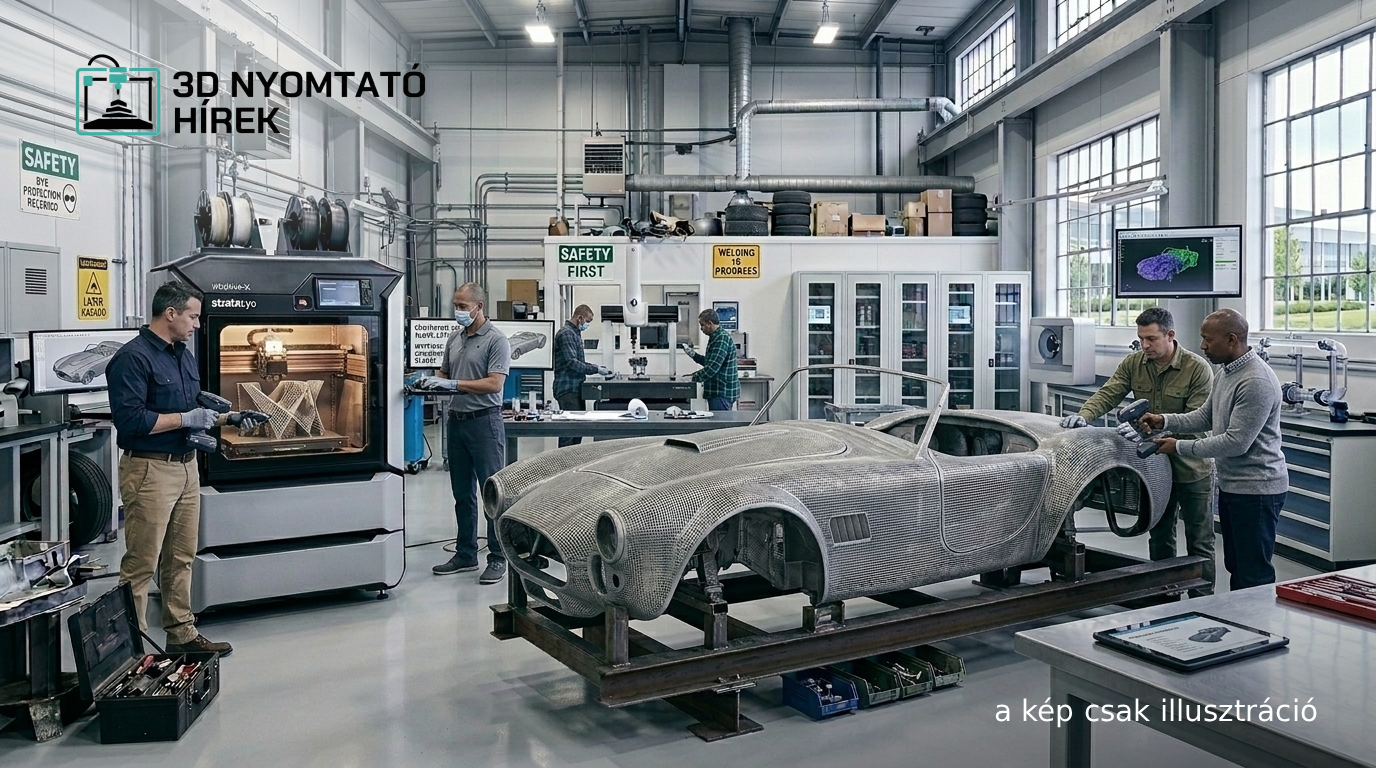
Consider this: you start with a blank sheet of paper, and exactly six weeks later, you are behind the wheel of a roaring sports car tearing across the tarmac. Sounds impossible? Yet, this is precisely what took place at the Oak Ridge National Laboratory (ORNL). This is no static scale model. It is a fully functional Shelby Cobra, produced almost down to the last fastener via additive manufacturing.
This changes everything. It is not merely a celebration of engineering creativity, but an uncompromising message to the traditional automotive industry: the era of drawn-out design cycles is over. While major OEMs deliberate over new vehicle platforms for years, this team went from ground zero to a completed vehicle in forty-two days. The pace is simply extraordinary.
The 3D-Printed Car and the Power of BAAM Technology
The core of the project is a system dubbed BAAM (Big Area Additive Manufacturing). This is not the desktop 3D printer sitting in a hobbyist workshop. It is an industrial behemoth engineered to fabricate large-scale structural components—including an entire chassis—layer by layer. BAAM shatters conventional manufacturing constraints, turning digital CAD files into physical reality in record time.
In additive manufacturing, you do not subtract material from a billet, nor do you cast molten metal into a mold. You build the geometry additively. This process drastically cuts material waste, utilizing only the volume strictly required for structural integrity. That is precisely the point.
Why choose the Shelby Cobra? The selection was deliberate. Marking the model's 50th anniversary, the car remains an enduring icon of American automotive engineering. However, the ORNL team had no intention of simply replicating the past. They integrated technologies that were unimaginable half a century ago. This vehicle is, in essence, a rolling research laboratory.
So, what is the next step?
Six Weeks: From Concept to Completion
When Lonnie Love, lead researcher at ORNL, announced their plan to 3D print an entire car, the reaction was largely met with skepticism. Conventional prototyping is an arduous process taking months or even years, requiring clay models and prohibitively expensive tooling. Here, the digital CAD dataset was streamed directly to the additive system. Once the chassis was printed, assembly commenced immediately.
Common perception—often misplaced—suggests that 3D printing is confined to brittle polymer prototypes. Observing this chassis in person quickly dispels that notion. The structure is remarkably rigid and robust. Engineers integrated internal lattice topologies within the chassis to optimize impact energy absorption—structures that are virtually impossible to produce using subtractive or formative methods.
The takeaway is clear: rapid cycle times do not compromise structural integrity; they are the direct byproduct of design freedom. There is no waiting for tooling fabrication or complex supply chain lead times. The workflow is streamlined directly from design to production.
That is the policy landscape. Here is the technical breakdown.
Surface Finishing: Transforming Raw Toolpaths into Class-A Surfaces
Anyone familiar with raw additive parts knows the surface finish is far from flawless. Layer lines and surface roughness are evident, bearing little resemblance to the exterior of a high-performance vehicle. In the case of the Shelby Cobra, however, distinguishing the printed substrate from a production body is impossible. This is where True Design stepped in, developing an advanced finishing protocol.
Through rigorous sanding, filling, and precision automotive paint application, they achieved a mirror-like, Class-A finish. The result is striking. The classic blue basecoat complemented by white racing stripes matches the aesthetic depth of high-end coachbuilt classics, proving that additive manufacturing can meet uncompromising cosmetic standards.
Beneath the refined exterior lies advanced technical architecture. The vehicle serves as a testbed for wireless charging systems and lightweight electric powertrains. ORNL did not simply build an automobile; they engineered an R&D platform for the future of mobility, validating components under operational conditions years before their potential rollout in series production.
Addressing the Cost Dynamics
A Paradigm Shift in Tooling
An underappreciated yet critical breakthrough emerged from this project. At the Detroit Auto Show, ORNL also showcased a 3D-printed production mold. Fabricating equivalent tooling from forged steel or billet aluminum typically demands six-figure investments and lead times measured in months. Utilizing additive manufacturing, the tool was produced in two days at a fraction of the cost.
This marks a genuine inflection point. Design studios and engineering teams can now manufacture functional production tooling on demand. Innovation barriers are effectively eliminated. Should a design require iteration, a revised version can be printed within 48 hours, bypassing extended procurement approval cycles.
Crucially, this manufacturing paradigm delivers significant gains in energy efficiency. Quantitative lifecycle analyses comparing conventional manufacturing to large-scale additive approaches revealed a dramatic reduction in embodied energy: additive processing stands among the most energy-efficient production methods available today.
Yet that is only part of the issue.
Implications for the Industry's Trajectory
The broader question is inevitable: when will production 3D-printed cars enter commercial dealerships? For high-volume mass production, conventional assembly lines will remain standard for the foreseeable future. However, early-stage automotive development has already changed permanently. Rapid additive prototyping enables engineering teams to execute iterative crash, ergonomic, and aerodynamic validations long before commercial release.
The 3D-printed Cobra demonstrates that manufacturing is no longer constrained by rigid, static tooling. It has transitioned into an agile digital workflow. Given an optimized CAD model and access to large-format additive platforms like BAAM, the constraints of traditional fabrication fall away, bounded primarily by computational design limits.
This level of technical agility is transformative. Radical engineering innovations no longer rely strictly on legacy industrial infrastructure; they require technical vision, validated models, and the proper deployment of advanced technology. The technological shift is already well underway.
Frequently Asked Questions
What is the total build time for a fully functional 3D-printed vehicle?
Throughout the ORNL project, the complete lifecycle—from initial digital concept to an operational vehicle—spanned just six weeks. Additive fabrication of the primary structural components accounted for a fraction of that window, with the remainder dedicated to powertrain integration, wiring, and surface finishing.
What material composition was utilized for the vehicle chassis?
The Shelby Cobra utilized a carbon-fiber-reinforced polymer composite. This advanced composite delivers a superior strength-to-weight ratio, ensuring high structural stiffness while minimizing total vehicle mass.
Are 3D-printed vehicles street legal?
While functionally operational, street-legal deployment requires rigorous regulatory compliance, including standardized crash-test certifications and homologation procedures. At present, these platforms function strictly as technology demonstrator and R&D testbeds.
Source: energy.gov / Department of Energy
Share: